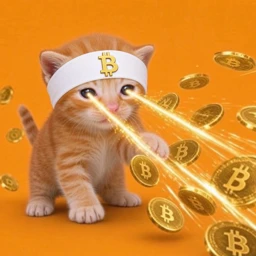
 Buy The Cat $BTC
Money once meant asking permission. A ledger you couldn't see, controlled by someone you had to trust. Send a coin twice and no one could stop you — unless a bank stood in the middle, taking its cut and its say.
Bitcoin didn't spring from nothing. For decades the cypherpunks — coders whose motto was "write code, not manifestos" — chased money no state could touch. David Chaum built digital eCash. Adam Back forged Hashcash, making a computer burn real effort to prove its work. Wei Dai sketched b-money; Nick Szabo designed bit gold, chaining proofs together like links.
Each got achingly close. Each hit the same wall: in an open network anyone can join, how do you stop a liar from voting a thousand times — with no referee at all? That last problem stood unbroken for ten years.
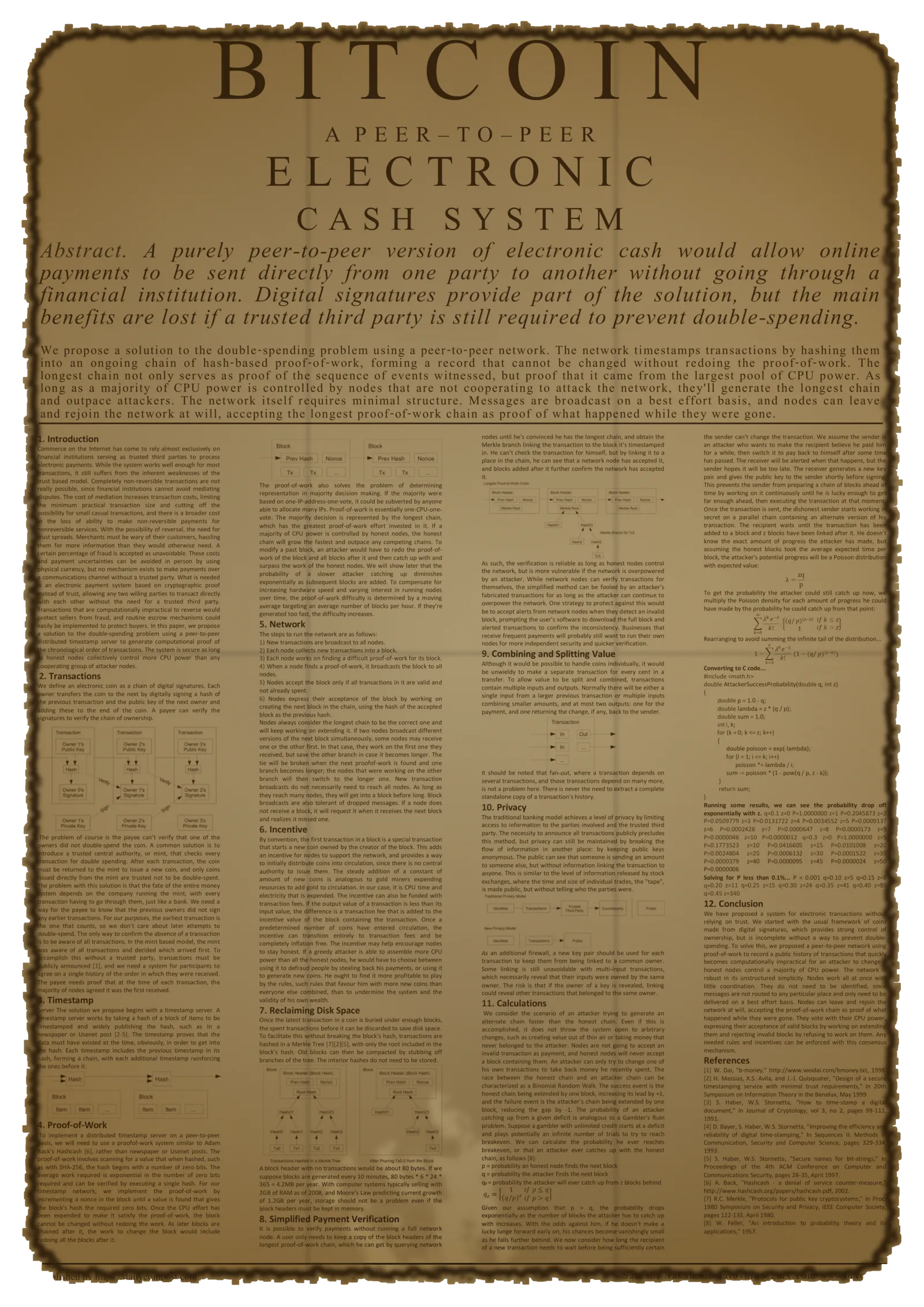
As banks buckled in the 2008 crisis, a stranger named Satoshi Nakamoto published nine pages on Halloween — a peer-to-peer electronic cash that needed no bank at all.
No CEO. No headquarters. No permission. Just a design: money anyone could send to anyone, verified by a whole network instead of a middleman taking its cut.
It cracked the problem that had stopped digital cash for decades — how to stop a coin from being spent twice — with no trusted authority in the middle. Trust, replaced by math.
It even named its ancestors, citing Wei Dai's b-money and Adam Back's Hashcash, and slipped out quietly over an old cryptography mailing list. Roughly eighteen months of work, handed to strangers.
The first block was mined with a message carved inside it: "Chancellor on brink of second bailout for banks." A timestamp, a headline, and a quiet declaration of independence.
The fifty coins that first block earned can never be spent — a quirk baked into the code. And for six days the chain stood alone in the dark, a single block, until the software went public and the world could finally join.
A cryptographer named Hal Finney saw the message, downloaded the software, and became the first person besides Satoshi to run the network. Days later Satoshi sent him ten coins — the first time Bitcoin ever passed from one human to another, sealed in block 170.
Finney had chased this dream his whole life, even building an early "reusable proof-of-work" before Bitcoin existed. His first words about it, typed to the world: "Running bitcoin." He died in 2014, taken by ALS — a patron saint of the ledger he helped switch on.
Miners burn real energy to seal each block onto the last. To fake the past you'd have to out-work the entire network — forever. So the ledger just... holds. Immutable by design.
Only 21 million bitcoin will ever exist. Every four years the new supply halves. No printer, no dilution — just a hard cap counting down. The world started calling it digital gold.
Then the creator walked away. Satoshi's last public words came in late 2010; by 2011 the keys and the code were handed to others, and the name went silent for good. No face, no farewell, no fortune spent.
The coins Satoshi mined in the early days — around a million of them, worth tens of billions today — have never moved. Not once. That untouched hoard is the proof no one owns Bitcoin, not even the one who made it.
On May 22, 2010, a coder paid 10,000 coins for two pizzas — the first time Bitcoin ever bought something real, worth about forty dollars then, hundreds of millions now. The community toasts that meal every year as Pizza Day. From a punchline it grew into a trillion-dollar network. HODL. Laser eyes. Diamond hands — a movement that turned patience into a battle cry.
Every legend breeds its ghosts. Mt. Gox, once handling most of the world's trades, collapsed with 850,000 coins gone. A man in Wales threw out a hard drive holding 7,500 coins — still buried under a landfill he's spent a decade fighting to dig up.
And still it climbed. In 2021 El Salvador made Bitcoin legal money for a whole country. The United States, after seizing coins from the dark-web market Silk Road, quietly became one of the largest holders on Earth — the very system built to escape governments, now sitting in their vaults.
On a faster chain called Solana, a mischievous cat curls up beside the ledger, tail flicking. It wears the same three letters — $BTC — and it has a plan. Buy The Cat.
Every $BTC move — not just trades, but any wallet-to-wallet send — leaves 3% behind. The cat gathers it into a shared pot and swaps it into wrapped Bitcoin, waiting for the pot to fill. No staking. No claiming. Just the toll, gathering as treasure.
When the pot swells past a sliver of the market cap, it bursts — wBTC scattered pro-rata across thousands of wallets at once. So far the cat has returned ~$720K in Bitcoin to holders. You did nothing but hold. The cat did the rest.
Satoshi gave the world a ledger no one could break. The cat gave it a heartbeat that pays. Two legends, three letters, one story still being written.